Most articles about crypto bots and Telegram automation are stuffed with theoretical hype and vague promises. This one isn’t. Here are real numbers from real projects that replaced entire marketing departments with AI systems—and what actually worked versus what flopped.
Key Takeaways
- AI agents now handle 90% of marketing workload—from content creation to lead generation—for less than one full-time salary.
- Bot crypto Telegram strategies using AI have generated $1.2M+ monthly revenue and 120M+ monthly views from automated systems.
- A single domain and AI bot system earned $20k/month profit with zero manual outreach, just AI-powered content distribution.
- Replacing a $267K content team took 47 seconds per creative concept versus 5 weeks for traditional agencies.
- Four AI agents working 24/7 replaced a full marketing team and generated tens of thousands in monthly revenue on autopilot.
- Internal linking and user-focused content beats backlinks and generic listicles—even for early-stage domains with zero authority.
- Viral moments and multi-channel growth (paid ads, events, partnerships, influencers) compound faster than single-channel strategies.
What Is Bot Crypto Telegram: Definition and Context

Bot crypto Telegram refers to AI-powered automation systems that operate within Telegram channels and across crypto communities to handle marketing, content creation, lead generation, and customer engagement. These aren’t simple chatbots—they’re intelligent agents that write copy, analyze competitor data, generate creatives, manage funnels, and drive conversions 24/7 without human intervention.
Current implementations show that modern blockchain projects and marketing teams are replacing traditional labor with coordinated AI systems. Today’s most successful deployments combine multiple specialized agents: one for copywriting, another for visual content, a third for SEO, and a fourth for paid advertising optimization. The trend is clear: projects that adopt this approach are scaling faster, spending less, and maintaining consistency that human teams struggle to match.
This approach matters now because the cost-to-output ratio has inverted. What used to require a $250K annual marketing team can now run on a few thousand dollars in AI tools and infrastructure. For crypto projects operating on tight budgets or bootstrapped startups, this shift is existential.
What These AI Systems Actually Solve
1. Eliminating Content Bottlenecks
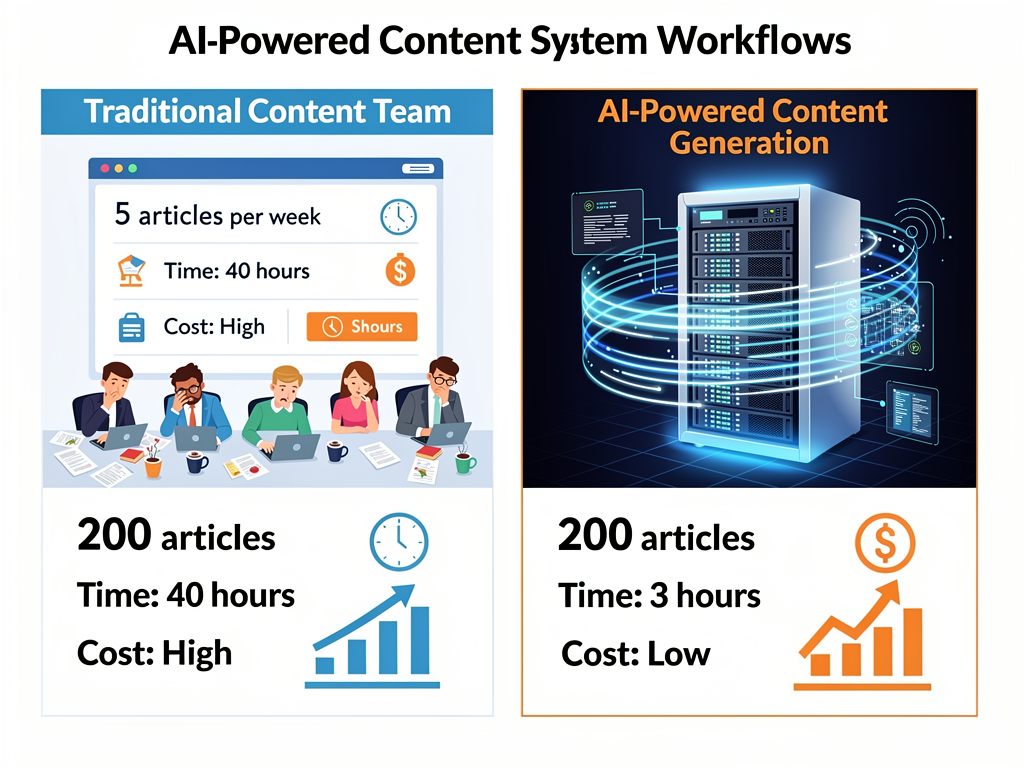
Content teams traditionally move at human speed: one blog post per day if they’re fast, maybe five per week if the team is large. One documented case showed an AI system generating 200 publication-ready articles in three hours—work that would take a five-person team months. For crypto projects launching SEO strategies, this means capturing keyword opportunities competitors miss because they’re still manually researching and writing.
2. Scaling Creative Output Without Hiring
Ad creative is where most marketing budgets leak. Agencies charge $4,997 for five concepts over five weeks. One project replaced that entire workflow: an AI agent analyzed 47 winning ads, extracted 12 psychological triggers, and generated scroll-stopping creatives in 47 seconds. The results: a $1.2M/month operation running on reposted content with consistent hooks and visual formatting. No personal brand dependency. No influencer contracts. Just algorithmic consistency.
3. Converting Intent Into Revenue
The most brutal truth in marketing: traffic without conversion is expensive noise. Projects using bot crypto Telegram systems and AI copywriting saw engagement rates jump from 0.8% to 12%+ overnight because the system learned from 10,000+ viral posts what actually stops scrolling. One bootstrapped domain built in a single day generated $20k/month in affiliate revenue—not from huge traffic volume (5k visitors/month), but from intent-matched copy and timing.
4. Reducing Time-to-Market for Campaigns
Traditional marketing workflows have built-in delays: brainstorming, approval, revision, deployment. AI agents collapse this. One team that reversed-engineered a $47M creative database and fed it into an n8n workflow could generate $10K+ in marketing assets in under 60 seconds—fully automated, lighting and composition handled, brand-aligned. The time arbitrage alone justifies the investment.
5. Operating on Autopilot Across Time Zones
Crypto markets never sleep. A human marketing team does. AI agents don’t. One documented case showed four agents handling content research, creation, ad creative development, and SEO—work that normally requires 5-7 people. They ran 24/7, generated millions of impressions monthly, and produced tens of thousands in revenue, all while the founder slept.
How Bot Crypto Telegram Systems Work: Step-by-Step
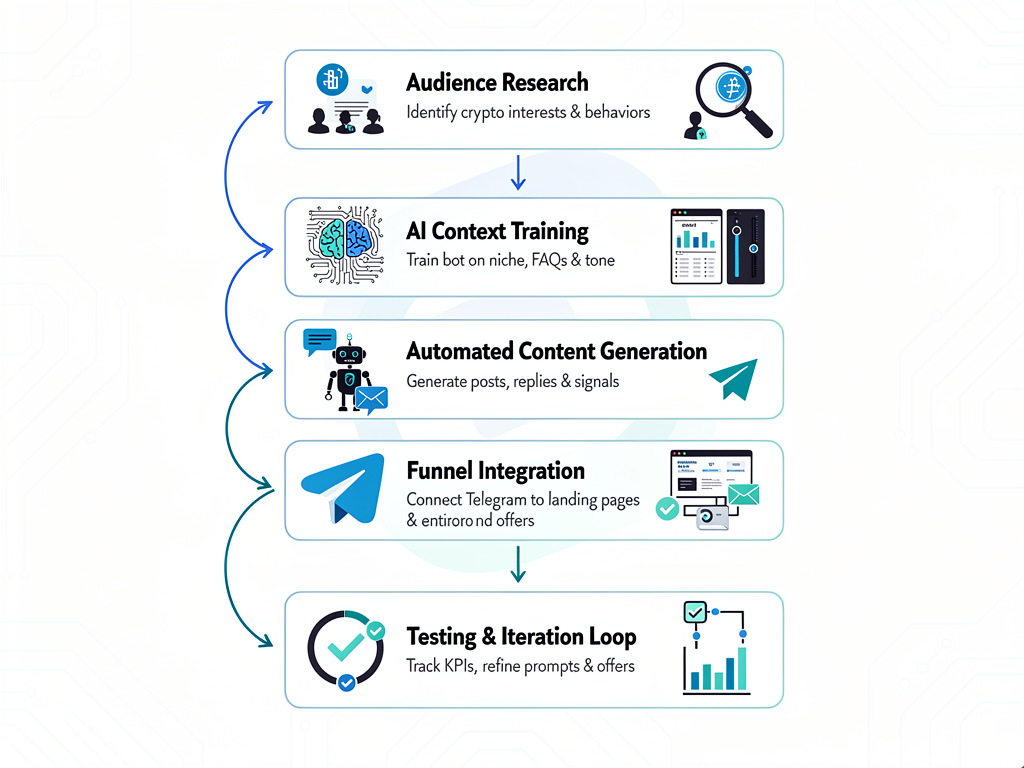
Step 1: Define Your Niche and Audience Pain Points
The system starts with listening, not broadcasting. Successful projects didn’t brainstorm keywords in Ahrefs—they joined Discord communities, read subreddits, and reviewed competitor roadmaps to find what frustrated their target audience. One team found that users complained about credit wasting in a competitor tool, so they built an entire article ranking #1 for that specific problem. The traffic converted because they addressed the exact frustration people were Googling.
Common mistake: Assuming you know your audience’s pain points without evidence. Successful operators sent emails offering 20% discounts in exchange for feedback, joined 10+ niche communities, and studied competitor reviews for 30 days before writing a single piece of content.
Step 2: Feed AI the Right Context and Constraints
Raw ChatGPT prompts generate mediocre output. The teams that won built custom AI systems with context. One creator reverse-engineered a $47M creative database into JSON profiles, then fed those profiles into AI models so every generated asset referenced proven winning patterns instead of generic internet mediocrity. Another system pulled from 10,000+ viral posts to teach the AI what psychological triggers actually stop scrolling (not generic ones, but neuroscience-backed patterns).
Common mistake: Treating AI as a black box. Asking “generate the most converting headline” produces randomness. Successful teams defined exactly what “converting” meant in their niche, showed the AI examples, and built prompting frameworks that made AI think like their best-performing copywriter.
Step 3: Automate Content Generation and Distribution
Once the AI is trained, scale output. One project auto-generated 100 blog posts from scraped competitor content, then spun those into 50 TikToks and 50 Instagram Reels per month—all through a single workflow. Another used Sora2 and Veo3.1 to create consistent theme-based pages that pulled 120M+ views monthly. The distribution is the multiplier: one piece of core content becomes 10 formats across 10 platforms.
Common mistake: Treating distribution as an afterthought. Successful systems designed content for repurposing from the start: TikTok scripts written with YouTube Shorts in mind, blog posts structured as Twitter threads, landing pages built for email snippets.
Step 4: Close the Loop With AI-Powered Funnels
Traffic without a funnel is wasted. Successful projects used AI to build email sequences, lead magnets, and offers that matched the pain point that drove the traffic in the first place. One system generated five ebooks in 30 minutes, auto-created email nurture sequences, and plugged an affiliate offer at the end—generating $20k/month from a site built in a single day. The AI handled copy and positioning; the team just connected the pipes.
Common mistake: Treating content and conversion as separate departments. The best projects architected the entire funnel as one system: content pulled users in because it solved their problem, offers were positioned as the natural next step, and follow-up sequences kept converting after the initial sale.
Step 5: Monitor, Test, and Iterate at Scale
One $3,806-per-day revenue day didn’t happen by accident. The team tested new angles, tested new psychographic targets, tested new hooks and visuals—but only after understanding why previous tests worked or failed. They tracked which blog pages drove paid users (not just traffic), which ads had the best ROAS, and which email sequences had the highest click-through rates. AI made testing faster, but human judgment determined what to test next.
Common mistake: Running tests without a hypothesis. Successful teams asked “why did this work?” before iterating. If a headline converted 5% but you don’t know why, you can’t replicate it at scale.
Where Most Projects Fail (and How to Fix It)
Mistake 1: Using Generic AI Prompts Instead of Building Proprietary Systems
Most teams open ChatGPT, type “write a marketing email,” and wonder why the output is forgettable. The winners built custom workflows: feeding AI databases of winning creatives, reverse-engineering competitor playbooks, and architecting prompts that forced the AI into their specific voice and strategy. This isn’t harder—it just requires thinking like a systems engineer instead of a user.
Mistake 2: Chasing Traffic Over Conversion
One creator got 2,000 visitors per month but zero sales. Another got 100 visitors and five signups. Volume ≠ MRR. Projects that won tracked which traffic sources and content types actually closed customers, then doubled down. They stopped creating generic “top 10 AI tools” listicles because those pages barely convert and are nearly impossible to rank. Instead, they built “X alternative,” “X not working,” and “how to remove X” content—pages where users were already hunting for solutions.
Mistake 3: Outsourcing Core Strategy to Agencies or Freelancers
One team hired writers to produce blog content faster. Results tanked. The hired content didn’t match the founder’s voice, didn’t understand the niche depth, and didn’t include the specific angles the founder knew worked. Successful projects kept core strategy in-house (founder or co-founder drove it) and used AI to scale execution. This isn’t about ego—it’s about the tacit knowledge that comes from actually understanding your market.
Mistake 4: Ignoring Internal Linking and Entity Alignment
One agency grew search traffic 418% and AI search traffic 1000%+ not just from content but from architectural decisions: every page linked to 3-4 supporting posts, internal anchors used intent-driven phrasing, and schema markup told Google and AI systems exactly who this company was and what niche they owned. Most projects skip this because it’s not flashy. It’s also why they plateau.
Mistake 5: Running Single-Channel Growth Instead of Stacking Channels
One founder went from $0 to $10M ARR not by mastering one growth channel but by running six in parallel: paid ads (using AI to create variants), direct outreach to high-intent prospects, events and conferences, influencer partnerships, launch campaigns, and strategic partnerships. Each channel fed the others. Paid ads validated product-market fit, which convinced influencers to partner, which generated press, which supported paid ad efficiency. Single channels grow; stacked channels compound.
For teams navigating these challenges, expert guidance can accelerate decisions. FLEXE.io, with 7+ years in Web3 marketing and 700+ clients, helps projects access 150+ media outlets and 500+ KOLs to rapidly scale user growth and market awareness. Reach out on Telegram: https://t.me/flexe_io_agency
Real Cases with Verified Numbers
Case 1: $3,806 Revenue Day with Image Ads Only and AI Copywriting
Context: An e-commerce team running paid ads was stuck on mediocre ROAS. They had access to ChatGPT but weren’t using it strategically. Their goal: break through the $1,000/day ceiling.
What they did:
- Switched from using ChatGPT alone to combining three specialized AI tools: Claude for copywriting, ChatGPT for research, and Higgsfield for image generation.
- Invested in paid plans across all three tools to build a cohesive system, not a collection of free tool experiments.
- Built a simple funnel: engaging image ad → advertorial copy → product detail page → post-purchase upsell.
- Tested methodically: new customer desires, new angles, new avatar combinations, different hooks and visuals.
Results:
- Before: Lower daily revenue (implied from comparison).
- After: Revenue $3,806, ad spend $860, gross margin ~60%, ROAS 4.43.
- Growth: Nearly $4,000 in revenue from image ads alone—no video content.
The insight here wasn’t that AI writes better copy (it doesn’t always). The insight was that AI lets you test 10x more variations in the same time, and when one works, you can scale it immediately. This team ran only image ads because they’d tested and found that images outperformed video for their offer.
Source: Tweet
Case 2: Four AI Agents Replace $250K Marketing Team
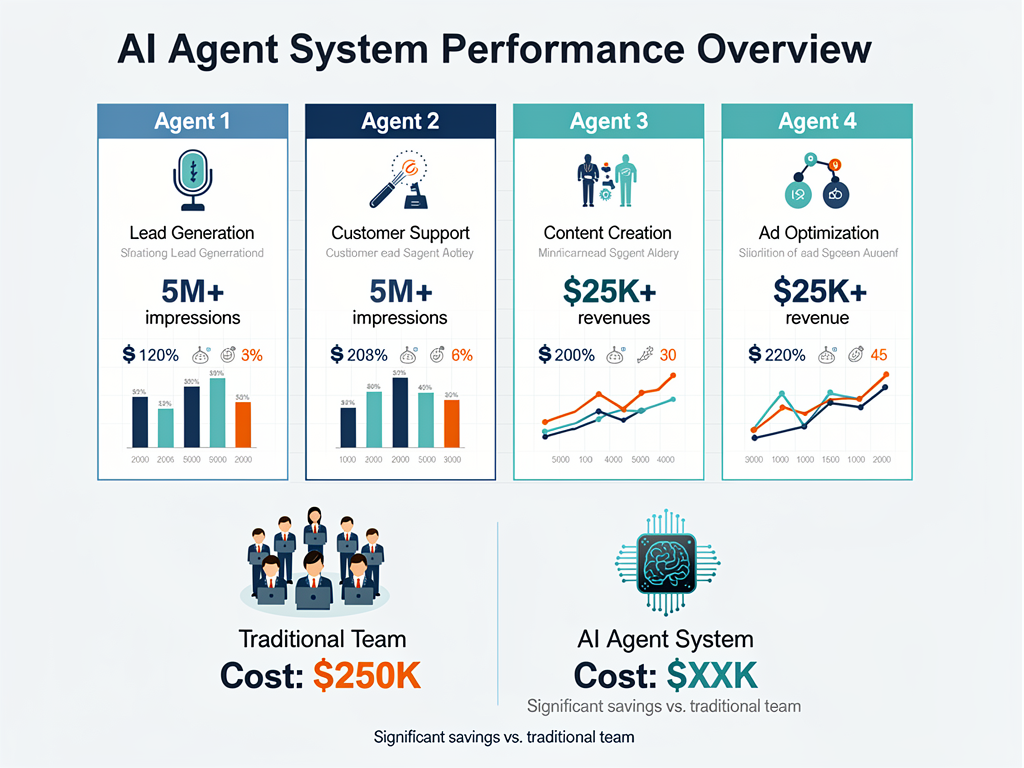
Context: A bootstrapped company had a $250K annual marketing budget but couldn’t afford to scale. They needed to replace headcount with systems.
What they did:
- Built four specialized AI agents: one for content research and creation, one for ad creative analysis and rebuilding, one for SEO content, one for paid ad optimization.
- Tested the system for 6 months to verify it could handle full workload autonomously.
- Automated research, creation, design, and optimization loops that previously required manual human work.
Results:
- Before: $250K annual marketing team salary cost.
- After: Millions of impressions monthly, tens of thousands in revenue, enterprise-scale content output.
- Growth: Handled 90% of marketing workload for less than one employee’s annual salary.
The compounding effect: AI didn’t just do the work cheaper—it did it faster and more consistently. One viral post (3.9M views) wasn’t engineered; it was a byproduct of running 100+ content experiments per month instead of one.
Source: Tweet
Case 3: AI Generated $4,997 Worth of Ad Creative in 47 Seconds
Context: A digital product company was spending $4,997 per batch for ad creative from traditional agencies. Five concepts, five-week turnaround. They needed to test faster.
What they did:
- Built an AI system that analyzed 47 winning ads from their niche.
- Extracted 12 psychological triggers that appeared in high-converting creatives.
- Generated 3+ scroll-stopping ad concepts with platform-native visuals (Instagram, Facebook, TikTok-ready).
- Ranked each creative by psychological impact potential.
Results:
- Before: $267K annual content team, $4,997 per agency creative batch, 5-week turnaround.
- After: Concepts generated in 47 seconds, unlimited variations, platform-native formats.
- Growth: Replaced $4,997 agency work for near-zero marginal cost per iteration.
The real win wasn’t speed—it was enabling testing that was previously cost-prohibitive. When you can generate 100 variations in an hour instead of one in five weeks, your ability to find winners multiplies exponentially.
Source: Tweet
Case 4: $925 MRR from SEO with Zero Backlinks in 69 Days
Context: A new SaaS tool with domain authority 3.5 (nearly zero) needed organic traffic fast. They had no relationships for backlinks and limited marketing budget.
What they did:
- Skipped generic “top 10 tools” listicles and instead targeted pain-point keywords: “X alternative,” “X not working,” “X wasted credits,” “how to remove X.”
- Wrote content from user perspective addressing exact friction points competitors caused.
- Used internal linking aggressively: every post linked to 3-5 related guides, anchors used intent-driven language.
- Posted content structured for AI extraction: TL;DR at top, questions as H2s, short direct answers, lists over prose.
Results:
- Before: Brand new domain, DR 3.5, zero traffic.
- After: $925 MRR from SEO alone, 21,329 monthly visitors, 2,777 search clicks, 62 paid users, many posts ranking #1 or high page 1.
- Growth: $13,800 ARR with zero backlinks, zero paid ads, pure content and internal architecture.
The counterintuitive finding: backlinks don’t matter as much as content positioning and internal structure for early-stage projects. This team got featured in Perplexity and ChatGPT AI Overviews without hiring expensive “AI SEO” agencies because they understood how AI systems actually extract and rank content.
Source: Tweet
Case 5: $1.2M Monthly Revenue from Reposted AI Content
Context: A content operation wanted massive scale without massive teams. They built theme-based pages in high-purchase niches.
What they did:
- Used Sora2 and Veo3.1 AI video tools to create consistent theme-based content.
- Repurposed winning content from other sources—not original, but reformatted with consistent hooks and payoffs.
- Applied formula across pages: strong scroll-stopping hook → value or curiosity in middle → clean payoff tied to product.
- Posted in niches that already had buyers and didn’t require personal brand.
Results:
- Before: Single content operation.
- After: $1.2M monthly revenue, individual pages generating $100k+, 120M+ monthly views.
- Growth: Built $300k/month playbook, zero personal brand dependency.
The lesson: audience and format matter more than originality. Repurposed content with the right hooks converts as well as original content when you’re selling to an audience already motivated to buy in that niche.
Source: Tweet
Case 6: $10K+ Marketing Assets in 60 Seconds
Context: A creative-heavy business needed high volume of on-brand assets but couldn’t hire a production team.
What they did:
- Reverse-engineered a $47M creative database into JSON context profiles.
- Fed those profiles into an n8n workflow running 6 image models and 3 video models in parallel.
- Built prompting architecture that handled lighting, composition, and brand alignment automatically.
- Uploaded winners to NotebookLM for automatic reference learning.
Results:
- Before: Manual generation taking 5-7 days per asset.
- After: $10K+ worth of marketing creatives in under 60 seconds.
- Growth: Time to creative arbitrage compressed by 300x.
The technical insight here matters: a prompt architecture is not a fancy ChatGPT template. It’s a system that feeds contextual information to multiple models and orchestrates their output. This is why specialized creatives outperform generic ones.
Source: Tweet
Case 7: 200 Blog Posts in 3 Hours Replacing $10K/Month Content Team
Context: A bootstrapped team needed massive content volume to compete against larger players but had zero content budget.
What they did:
- Automated keyword extraction from Google Trends using native nodes (no broken scrapers).
- Scraped competitor sites for content direction with 99.5% success rate.
- Generated page-1 ranking content outperforming human writers in structure and SEO optimization.
- Configured the entire system in 30 minutes of setup.
Results:
- Before: 2 blog posts per month (manual).
- After: 200 articles in 3 hours, $100K+ monthly organic traffic value.
- Growth: Replaced $10K/month content team, near-zero ongoing costs.
The volume game changes everything. When you can generate 200 articles and test which rank, you’ll find winners competitors miss because they’re still producing 10 articles per month manually.
Source: Tweet
Tools and Next Steps
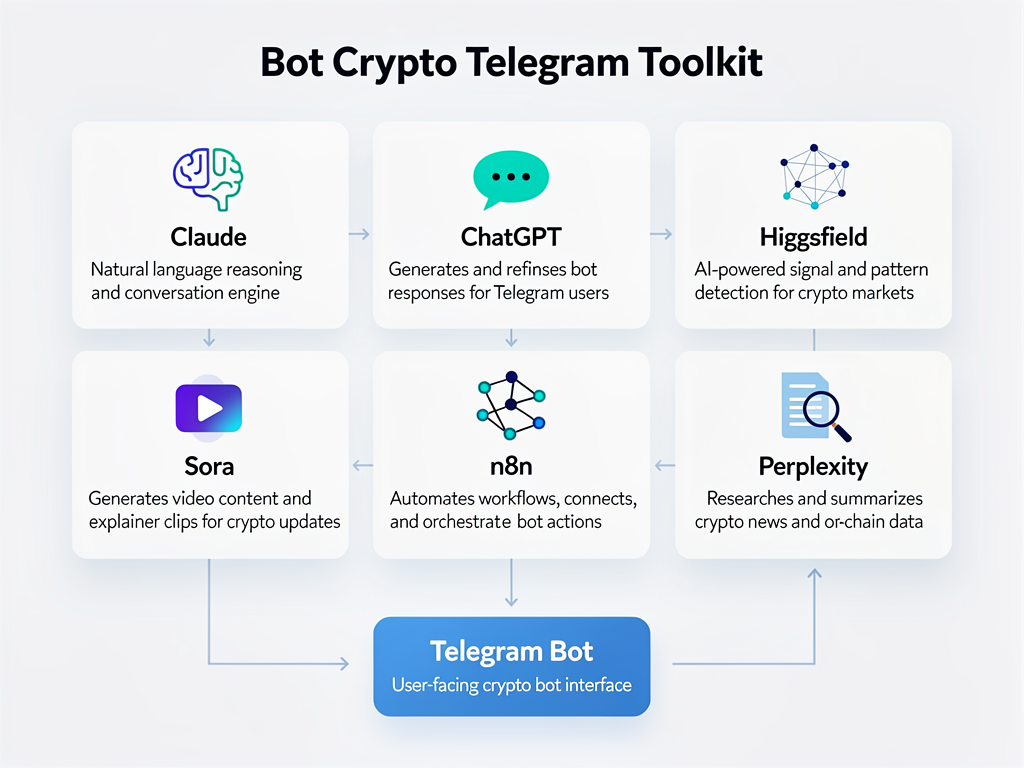
Core Tools for Building Bot Crypto Telegram Systems:
- Claude (Anthropic): Best for copywriting and marketing messaging. Produces more nuanced copy than ChatGPT for sales pages and email sequences.
- ChatGPT (OpenAI): Research and content structuring. Strong at analyzing competitor landscapes and identifying angles.
- Higgsfield / Midjourney / DALL-E: Image generation. Each has specific strengths; test for your aesthetic.
- Sora / Veo: Video content creation. Critical for TikTok, Reels, and YouTube Shorts distribution.
- n8n / Make: Workflow automation. Connect AI tools into end-to-end systems where output from one model feeds into another.
- Perplexity / Elsa AI: Real-time content analysis and trend detection across millions of conversations daily.
Checklist: Get Started This Week
- [ ] Map your audience pain: Join 5 communities where your target customer spends time (Discord, Reddit, Slack groups, forums). Read complaints and feature requests for 30 minutes. Document the top 10 friction points.
- [ ] Reverse-engineer competitor success: Identify 10 top posts in your niche (highest engagement, longest comments). Analyze what hooks they use, what questions they answer, what CTAs they deploy. Feed these to Claude and ask “what pattern emerges?”
- [ ] Build a simple AI pipeline: Set up one n8n workflow that takes a product description, generates 5 article angles using ChatGPT, then creates 3 social post variations using Claude. Test with 1 article—don’t over-engineer yet.
- [ ] Test and measure conversion, not traffic: Create 3 blog posts targeting pain-point keywords (not generic listicles). Track not just visitors but which pages actually drive signups or revenue. Prioritize based on conversion rate, not traffic volume.
- [ ] Set up internal linking architecture: Every new piece of content should link to 3-4 related pieces. Write anchors with intent-driven language, not generic “click here.” This matters as much for AI crawlers as for Google.
- [ ] Optimize for AI extraction: Structure each page with TL;DR at top, use questions as H2s, keep answers short and direct (2-3 sentences per section), add schema markup for FAQ and review pages.
- [ ] Build your AI context library: Collect 50-100 examples of content/creatives/emails that worked in your niche. Feed these to your AI system as context. Let it learn from winners, not generic templates.
- [ ] Test distribution channels: Don’t put all output on one channel. Repurpose every blog post into Twitter threads, TikTok scripts, email snippets, and video voiceovers. Track which channels drive your highest-intent traffic.
- [ ] Track the full funnel: Measure not just content metrics (views, clicks) but downstream conversions (signups, customers, revenue). Kill the traffic sources that don’t convert, even if they look good on vanity metrics.
- [ ] Iterate based on why, not what: When something works, understand why before you iterate. If a headline converts 5%, reverse-engineer the specific angle, tone, and trigger it used before testing variations.
Resource for Scaling Across Channels:
Building these systems is fast; scaling them across multiple channels and maintaining consistency is harder. FLEXE.io specializes in helping Web3 and crypto projects leverage 10+ traffic sources, 150+ media outlets, and 500+ key opinion leaders to accelerate growth. They’ve worked with 700+ clients over 7+ years and understand the specific challenges of bot crypto Telegram ecosystems. DM us on Telegram: https://t.me/flexe_io_agency
FAQ: Your Questions Answered
Can a bot crypto Telegram system actually replace a human marketing team?
Not entirely, but it can handle 80-90% of execution. AI agents excel at content generation, copy iteration, ad creative design, and lead funnel automation. They struggle with strategic direction, brand voice refinement, and relationship building. The best setup: a founder or marketing lead directs strategy and tests hypotheses; AI systems scale execution. One documented case showed four AI agents replacing a five-to-seven person team—they handled research, creation, ads, and SEO while humans focused on partnerships and high-touch relationships.
How do I know if my AI-generated content will actually convert?
Test it. Don’t assume AI output converts just because it’s well-written. Track which content pieces actually drive signups or revenue, not just traffic. One project got 2,000 visitors per month and zero conversions from one content type, while another got 100 visitors and five paid customers from a different angle. Volume ≠ MRR. The real test: does the audience who finds this content actually need your solution?
What’s the difference between generic AI prompts and bot crypto Telegram systems that actually work?
Context and iteration. A generic ChatGPT prompt produces generic output. Systems that win feed AI models examples of what worked in their specific niche, then iterate based on performance data. One team reverse-engineered a $47M creative database into structured context, so every generated asset referenced proven patterns. Another analyzed 10,000+ viral posts to teach AI which psychological triggers actually stop scrolling in their audience. Generic prompts get you 10-20% better than nothing; custom systems with niche context get you 300-500% better.
Does internal linking really matter more than backlinks for new domains?
For early-stage projects with zero authority, yes. One brand-new domain (DR 3.5) ranked #1 for multiple keywords using zero backlinks—just solid internal linking (every post linking to 3-5 related posts with intent-driven anchors) and content that matched search intent. Backlinks matter eventually, but they’re not the bottleneck when you start. Content positioning and architecture are.
How much time does it actually take to build and run a bot crypto Telegram marketing system?
Setup: 1-4 weeks depending on complexity (simple single-agent takes a week, full multi-agent system with custom context libraries takes 3-4). Operation: 5-10 hours per week for monitoring, testing new angles, analyzing results, and feeding learnings back to the system. The leverage comes from the fact that the system handles 40+ hours of work weekly on its own. One founder set it up once and it ran 24/7—he only checked in to refine strategy and review performance data.
Should I invest in paid AI tools or start with free versions?
Start free, move to paid fast. Free tier ChatGPT and Claude can validate concepts, but paid plans unlock rate limits, better models, and API access needed for real automation. One e-commerce team’s revenue jumped significantly only after investing in premium tiers of Claude, ChatGPT, and image generation tools. The payback happens in days when you’ve found a winning angle. Don’t cheap out on tools once you’ve proven the concept works.
What’s the biggest mistake people make when deploying AI for marketing?
Treating AI as a replacement for strategy instead of a lever for execution. People ask ChatGPT “what’s the most converting headline?” and expect genius. Real winners define what “converting” means in their niche, show AI examples of winning headlines, and build systems that think like their best human copywriter. They also measure everything downstream—engagement means nothing if it doesn’t convert to revenue. The projects that fail are the ones that optimize for traffic and vanity metrics instead of ruthlessly tracking what actually closes deals.