Most articles about blockchain PR are packed with generic advice about press releases and media lists. This one isn’t. You’ll see real numbers from real projects—what actually moved the needle, what flopped, and exactly how they did it.
Key Takeaways
- AI-driven content creation combined with strategic distribution channels is replacing traditional blockchain PR, with proven results ranging from 418% organic growth to $10M+ ARR.
- Successful blockchain PR today focuses on solving real user pain points, not hype—projects ranking high in search and AI Overviews prioritize extractable, intent-driven content.
- Automation at scale—whether through AI agents, theme pages, or SEO workflows—is now the baseline. Single-person teams are executing work that traditionally required full marketing departments.
- Viral moments compound growth, but multi-channel strategies (paid ads, influencer partnerships, events, direct outreach) sustain momentum from zero to $10M+ ARR.
- Blockchain projects winning attention in 2025 combine human insight (user feedback, competitor analysis) with AI execution (content generation, creative production, distribution automation).
- Internal linking, semantic organization, and entity alignment are critical—not for SEO alone, but for visibility across Google, ChatGPT, Perplexity, and emerging AI search platforms.
- Content prep time has collapsed from weeks to hours or minutes; the real differentiator is taste, originality tracking, and audience-first positioning over trend-chasing.
Introduction: Why Blockchain PR Has Changed Completely
Blockchain PR used to be straightforward: write a press release, send it to crypto journalists, hope for coverage. That era is over. Today’s winning blockchain projects use AI to generate content at scale, deploy it across multiple channels simultaneously, and measure success not by media mentions but by user acquisition, search visibility, and citations in AI systems.
The fundamental shift is this: blockchain PR is no longer about getting your name in the news. It’s about being where your users already are—in search results, AI Overviews, social feeds, and community discussions—with content that actually solves their problems. Projects that understand this are growing from zero to millions in ARR in months. Projects still chasing traditional coverage are losing ground.
What follows are real case studies from founders and operators who cracked this code. You’ll see the exact workflows, the numbers before and after, and the mistakes that cost them weeks or months.
What Is Blockchain PR: Definition and Context
Blockchain PR today is the practice of building visibility, credibility, and user acquisition for crypto projects through AI-accelerated content, strategic distribution, and community engagement—not through traditional media relations alone.
Current implementations reveal a sharp split between projects still relying on agency press releases and those automating content creation across search, social, and AI platforms. Modern blockchain PR leaders are using tools like Claude for copywriting, AI agents for content generation, and platforms like Perplexity and ChatGPT to secure organic citations. They’re measuring success in organic traffic growth, search rankings, and AI Overview appearances—metrics that directly drive user onboarding and token adoption.
This approach is for blockchain projects that need to grow fast with limited budgets, founders bootstrapping from zero to product-market fit, and teams tired of paying agencies $50K+ for generic “thought leadership” that doesn’t move the needle. It’s not for projects expecting traditional PR placements in mainstream media or for those without a differentiated product story.
What Effective Blockchain PR Actually Solves
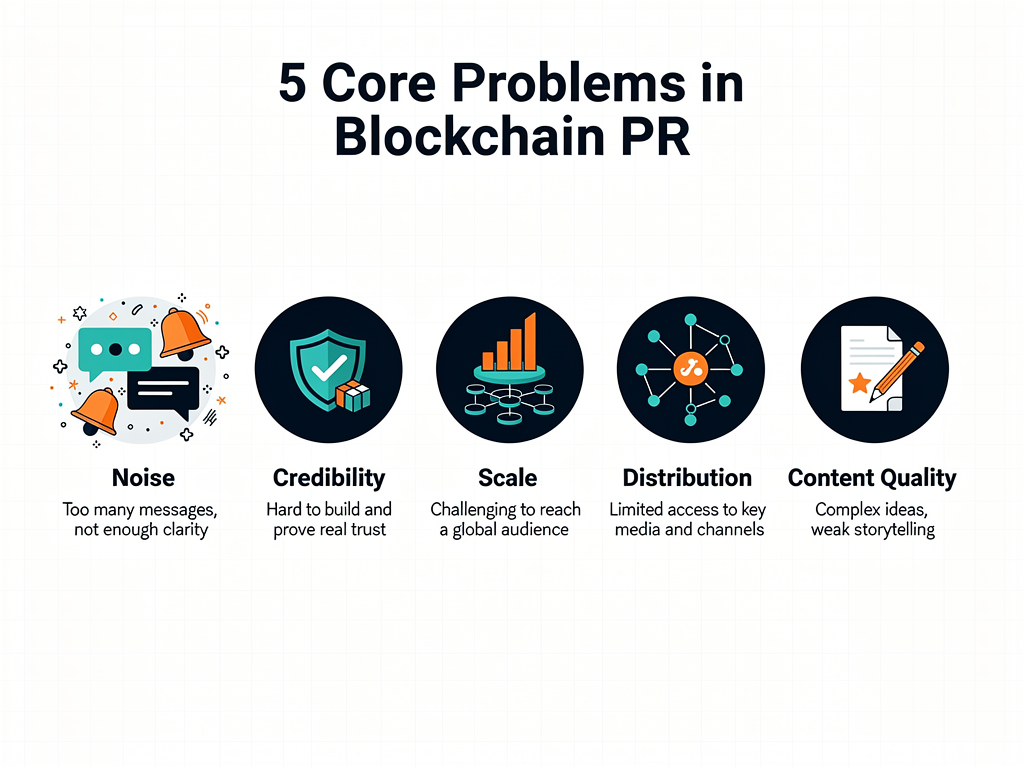
1. The Noise Problem: Getting Found When Everyone Is Claiming “Revolutionary”
In crypto, thousands of projects are launching monthly, and nearly all claim to be revolutionary. Most blockchain PR fails because it amplifies the same tired narrative. Users searching for alternatives or solutions find generic listicles and paid placements, not honest information.
Successful blockchain PR today targets user pain points directly. One SaaS founder documented this approach: instead of writing “Top 10 AI Tools,” they wrote articles like “X Not Working” and “How to Remove X from Y for Free.” These pages ranked immediately, converted visitors to users, and generated $925 MRR in SEO revenue alone within weeks. The insight: people searching for problems are ready to buy solutions. Blockchain projects applying this principle—creating content around “Why I Left Cardano for Solana” or “DeFi Bridge Alternatives”—are capturing users mid-journey when intent is highest.
2. The Credibility Gap: Building Authority Without Decades of History
New blockchain projects have no brand history, no backlinks, no citations. Traditional SEO and PR demand years to build. Emerging solutions reverse this by stacking authority signals intelligently: content structured for AI extraction (TL;DRs, question-based headers, lists), backlinks from high-authority domains in the niche, schema markup for brand and team trust signals, and semantic internal linking.
One agency competing against global SaaS firms with multimillion-dollar marketing budgets grew search traffic 418% by repositioning their content to commercial intent and building links from DR50+ domains with entity alignment. They went from a domain rated 3.5 to ranking across Google, ChatGPT, Gemini, and Perplexity—zero ad spend. For blockchain projects, this playbook means: stop writing generic thought leadership; start building extractable answers to commercial queries like “Best Solana DEXes” with proper schema and strategic links.
3. The Scale Problem: Traditional Content Teams Can’t Keep Pace
Hiring writers, designers, and managers scales slowly and expensively. Four AI agents (content research, creation, ad creative, and SEO) replaced a $250,000 marketing team while handling 90% of the workload. Another operator built a Creative OS that generates $10K+ in marketing assets in under 60 seconds—work that agencies charge $4,997 for, with 5-week turnarounds.
For blockchain PR, this means: a single founder using Claude + ChatGPT + Higgsfield can produce copywriting, research, and visuals daily. One operator generated 3.9M post views using image ads alone, achieving 4.43 ROAS with $3,806 daily revenue. The barrier to professional-grade blockchain PR has collapsed.
4. The Distribution Bottleneck: One Channel Isn’t Enough
Blockchain projects often go all-in on one platform (usually Twitter or a subreddit) and plateau. Projects scaling to $10M+ ARR use six parallel channels: paid ads, direct outreach, conferences and events, influencer partnerships, coordinated launches, and strategic partnerships. One company grew from $0 to $833K MRR by systematically testing each channel, tracking which ones moved the needle for user acquisition, and reinvesting into winners.
For blockchain PR: if your content only lives on your blog and you hope for retweets, you’re leaving 90% of distribution on the table. Real blockchain PR today means repurposing one piece of content into blog posts, social threads, videos, email sequences, and community discussions simultaneously.
5. The Taste Problem: AI-Generated Content That Doesn’t Sound Like Slop
Raw AI output is detectable, forgettable, and often fails to convert. The winners reverse-engineer successful content first, then use AI to scale it. One operator analyzed 10,000+ viral posts, reverse-engineered psychological triggers and narrative frameworks, and built a system that turned vanilla AI prompts into consistent 50K+ impression posts (up from 200). Engagement rates jumped from 0.8% to 12%+, and follower growth went from stagnant to 500+ daily.
For blockchain PR: feed AI your best-performing content, competitor winners, and community feedback—not generic prompts. Use AI to iterate and scale, not to replace the initial thinking. One founder created 2,000 templates using 90% AI and 10% manual taste-work; that 10% was the entire differentiator.
How Modern Blockchain PR Works: Step-by-Step
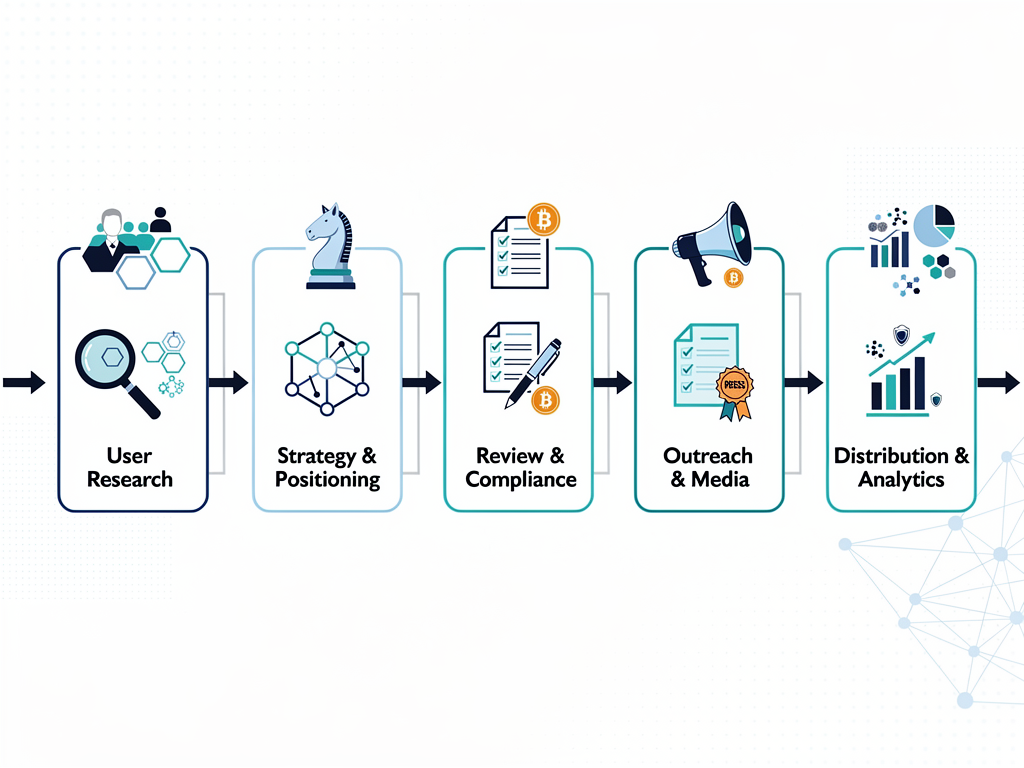
Step 1: Identify Real User Pain Points, Not Trends
Start by listening, not brainstorming. Join Discord servers, subreddits, and communities where your target users congregate. Look at competitor roadmaps, GitHub issues, and support chats. Note what frustrates them, what features they request, what tools they’ve abandoned.
One SaaS founder found a recurring complaint: users couldn’t export code from a specific tool. They wrote an article around this exact problem, added a relevant CTA, and the content ranked immediately and converted well. The workflow is simple: pain point → search query → content → product solution.
For blockchain PR: if your community is frustrated with slow bridging times, write “Fastest Cross-Chain Bridges” or “Why Bridge X Is Slower.” If users complain about DEX UI, document “Best UX in DeFi” with side-by-side comparisons. Listen first, write second.
Step 2: Reverse-Engineer Winning Formats and Psychology
Before you prompt Claude or ChatGPT, study what already works. Look at top posts in your niche. What hooks stop the scroll? What structure keeps readers engaged? What CTAs convert?
One operator analyzed winning ad creatives, extracted psychological triggers (social proof, urgency, curiosity, fear of missing out), and built a system that architectures viral content using these patterns. Instead of asking ChatGPT “generate a catchy headline,” they fed it frameworks: “Curiosity gap hook + social proof + clear benefit + strong CTA.” The results jumped from 12 likes per post to 50K+ consistently.
For blockchain PR: before your first article, study top-ranking pieces about your niche. What are the headers? How long are the sections? What proof (numbers, screenshots, testimonials) do they include? Then brief your AI with these structural patterns, not just topic keywords.
Step 3: Use AI to Scale Structure, Not Replace Thinking
The winning workflow is: record your core idea manually (1–2 paragraphs from human thinking), then use AI to expand with structure, examples, and formatting. One founder recorded rough content notes, then prompted Claude specifically: “Turn this into an article using question-based headers, 2–3 sentence answers, lists, and callout blocks for Google and AI extraction.”
Result: fast, human-sounding, AI-optimized. Another operator generated 200 publication-ready articles in 3 hours by extracting keywords from Google Trends, scraping competitors (99.5% success, never blocked), and feeding these inputs into a workflow that generated ranking content outperforming human-written pieces.
For blockchain PR: don’t hand-off to ChatGPT with “write a blog post about DeFi security.” Instead: write a 3-point outline from your own thinking, give it to Claude with specific structural instructions (extractable headers, TL;DR, FAQ), and edit for your tone. The AI handles speed and scale; you handle direction and taste.
Step 4: Structure Content for Both Humans and AI Systems
Content now lives in two worlds: Google’s traditional ranking signals and AI Overviews (Gemini, ChatGPT, Perplexity). Both reward extractable structure.
The formula: TL;DR at the top (2–3 sentences answering the core question) + question-based headers (“What makes a good blockchain validator?”) + short, direct answers (2–3 sentences per section) + lists and factual statements over opinion + schema markup for entity alignment (your project name, location, category) + internal links to related pages.
One agency using this structure landed over 100 AI Overview citations. Why? Because LLMs extract content blocks from pages with clean, question-based hierarchy. Blockchain projects structuring their blog this way—instead of long-form essays—are seeing immediate AI search visibility.
For blockchain PR: add a TL;DR to every article. Use headers as questions. Keep paragraphs to 2–3 sentences. Include lists instead of flowing text wherever possible. This alone will increase AI citations and user findability.
Step 5: Distribute Across Multiple Channels Simultaneously
One blog post can become: a Twitter thread, a LinkedIn post, a TikTok script, a YouTube video outline, an email newsletter segment, a Discord community discussion, and an ad creative. Repurposing is faster than creating from scratch.
One operator created a single X profile in a niche, repurposed influencer content with AI, generated hundreds of posts, and auto-scheduled 10 per day. Result: 1M+ monthly views, a DM funnel to his product, and $10K/month profit. The insight: one well-distributed piece beats ten pieces with no distribution.
For blockchain PR: after publishing a blog post, spend 30 minutes repurposing: extract 3 key points for a Twitter thread, 5 quotes for LinkedIn, script it for YouTube Shorts, send it to your email list, and pin it in your Discord. Automation tools (Buffer, Zapier, n8n) can schedule these automatically.
Step 6: Use Internal Linking to Build Entity Clarity
Google and AI systems parse websites as knowledge graphs. If your pages are siloed (each post standalone, no cross-links), they’re invisible to both. Semantic internal linking—where every page links to 3–5 related pages using intent-driven anchor text—is now as important as backlinks.
One agency saw a jump from page-1 Google ranking to consistent AI Overview appearances after rebuilding their internal linking structure. Every service page links to supporting blog posts; every blog post links back to service pages; anchors use intent-driven phrasing (“enterprise Solana validators”) not generic words (“learn more”).
For blockchain PR: map your content silos. If you have a page on “How to Stake,” ensure it links to “Top Staking Pools,” “Staking Rewards Calculator,” and “Validator Risk Assessment.” This signals to Google and Claude that your site is a comprehensive authority on staking.
Where Most Blockchain Projects Fail (and How to Fix It)
Mistake 1: Writing Generic “Thought Leadership” Nobody Searches For
Agencies and inexperienced teams write blog posts like “The Future of Blockchain Is Now” or “Why Web3 Matters”—content with zero search volume, zero intent, and zero conversions. These posts feel professional but drive no users.
What happens: you publish 10 articles, get minimal traffic, and conclude your niche doesn’t value content. The real issue: you’re not writing about what users are actually searching for.
Fix: before writing, use Google Trends, Ahrefs, or Semrush to verify search volume. Better yet, listen to your community. If 20 Discord users complain about validator downtime, write “How to Prevent Validator Downtime” or “Best Solana Validator Monitoring Tools.” If users ask “Is Cardano Dead?”, write that article. Real intent beats assumed expertise every time.
Mistake 2: Ignoring AI Systems (Google Overviews, ChatGPT, Perplexity) in Your SEO Strategy
Many blockchain teams still optimize only for Google’s traditional blue links. But ChatGPT and Perplexity now answer queries directly, citing sources. If your content isn’t structured for AI extraction, you won’t appear—even if you rank on Google.
What happens: you rank for “Best DeFi Protocols” but ChatGPT cites your competitor because their content has a TL;DR and question-based headers.
Fix: add schema markup (JSON-LD) for your brand, team, and organization. Structure every post with a TL;DR at the top, question-based headers, and short extractable answers. Link to related posts semantically. One agency added these changes and went from zero AI citations to over 100 across Gemini, ChatGPT, and Perplexity.
Mistake 3: Depending on Paid Ads Alone, Skipping Organic Growth
Blockchain projects often burn through ad budgets ($10K/month paid ads, $0 organic) and panic when CPMs rise or platforms change algorithms. Organic channels (search, community, content) take longer to build but are far cheaper at scale.
What happens: your ad campaign ends, traffic stops. Your blog posts are evergreen.
Fix: invest 30% of marketing effort in organic (blog, SEO, content distribution) alongside paid. One founder built a site with 21,329 visitors from search alone, generating $925 MRR, with zero paid ad spend. Another grew a product to $50K MRR primarily through blog content and video education. Organic compounds; paid doesn’t.
Mistake 4: Using Raw AI Output Without Human Taste or Testing
Feeding ChatGPT a prompt and publishing the result is faster but noticeably flat. Users disengage. Engagement rates stay below 2%.
What happens: your content ranks but doesn’t convert. Users click and leave.
Fix: use AI for first drafts and scaling, not final output. Write your outline manually first. Feed it to Claude with specific structural and tone requirements. Edit the result for voice, accuracy, and originality. One operator cut AI-generated content through a review filter checking for overused phrases, clichés, and weak hooks. Engagement jumped from 0.8% to 12%+.
When blockchain projects need expert guidance navigating these common pitfalls—especially in building cohesive PR strategies across content, SEO, and AI visibility—FLEXE.io, with 7+ years in Web3 marketing and 700+ clients, helps teams access 150+ media outlets and 500+ KOLs to accelerate growth and avoid costly mistakes. Reach out on Telegram: https://t.me/flexe_io_agency
Mistake 5: Chasing Backlinks Instead of User Intent
Teams waste weeks doing “link swaps” or paying for low-quality backlinks. Meanwhile, their content isn’t solving user problems, so even with links, traffic and conversions stay flat.
What happens: you get 100 backlinks but only 5 organic sessions per month because your content doesn’t rank or doesn’t convert.
Fix: focus on user intent first, backlinks second. One founder built a blog with zero backlinks but 21,329 monthly visitors by targeting keywords with clear buying intent. Internal linking mattered 100x more than external links in their case. Blockchain projects should do the same: write for your users first, then build links from relevant high-authority domains only if needed (many won’t be).
Real Cases with Verified Numbers
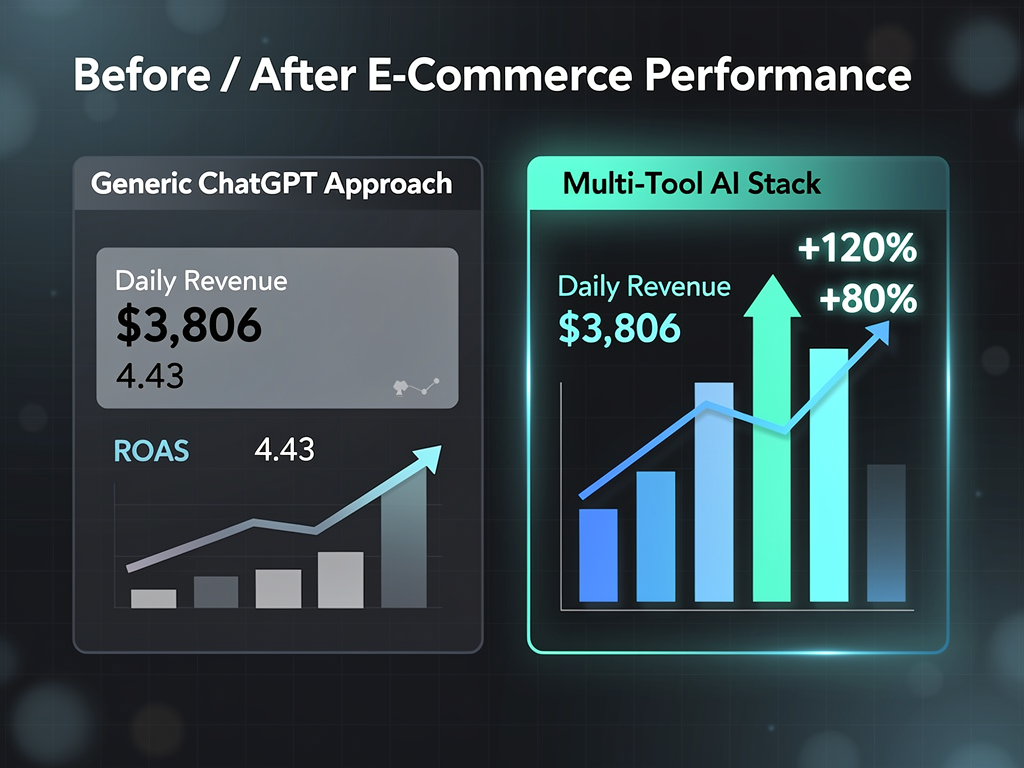
Case 1: E-commerce Operator Achieves $3,806 Daily Revenue Using AI Copywriting and Image Ads
Context: An operator running ads for e-commerce clients realized they were leaving money on the table by relying solely on ChatGPT for copywriting. They needed a smarter system to write high-converting ad copy, generate research, and produce visuals.
What they did:
- Switched from ChatGPT alone to a three-tool stack: Claude for copywriting, ChatGPT for research, Higgsfield for AI-generated images.
- Invested in paid plans for each tool ($300–500/month combined) to unlock better outputs and higher usage limits.
- Built a simple funnel: engaging image ad (AI-generated) → advertorial → product detail page → post-purchase upsell.
- Tested new customer desires, angles, avatar segments, and visual hooks systematically, iterating based on performance data.
Results:
- Before: Not specified, but implied lower conversion rates with generic ChatGPT copy.
- After: Day 121 revenue $3,806, ad spend $860, ROAS 4.43, margin ~60%.
- Growth: Nearly $4,000 daily profit using image ads only (no videos). Over 121 days, this compounds to significant revenue.
Key insight: The lesson for blockchain PR is straightforward: don’t rely on one tool. Use specialized AI for different tasks (copywriting, research, creative), and invest in quality outputs. Claude’s copywriting outperformed ChatGPT; combining them amplified results.
Source: Tweet
Case 2: Marketing Operators Replace $250K Team with Four AI Agents, Achieving Millions in Monthly Impressions
Context: A team managing multiple client campaigns was paying $250K/year for a 5–7-person marketing team. They recognized that content research, creation, ad creative analysis, and SEO could be automated. They built four AI agents in n8n to handle these tasks.
What they did:
- Built Agent 1 to research trending topics and content gaps.
- Built Agent 2 to generate custom email newsletters (Morning Brew-style).
- Built Agent 3 to analyze competitor ads, extract winning elements, and rebuild them.
- Built Agent 4 to generate SEO content targeting high-intent keywords.
- Deployed the system to run 24/7 on autopilot.
Results:
- Before: $250K/year marketing team salary + benefits + operational overhead.
- After: One-time setup cost (~$5K in tools/infrastructure) + $500/month running costs. Millions of impressions generated monthly. Tens of thousands in revenue on autopilot. 3.9M views on a single viral post created by the agents.
- Growth: Removed 90% of routine work. The four agents handle research, content creation, ad creative analysis, and SEO that would normally require 5–7 people. Freed up human team to focus on strategy and creative direction.
Key insight: Blockchain projects don’t need full marketing teams. They need to automate 80% of routine work (content generation, research, ad analysis) and focus human effort on strategy. This cuts costs 90% while maintaining or improving output quality.
Source: Tweet
Case 3: AI Ad Creative Agent Replaces $267K Content Team, Generating Ad Concepts in 47 Seconds
Context: A SaaS founder had a $267K/year content team producing ad concepts. Agencies were charging $4,997 per campaign for 5 concepts with a 5-week turnaround. They built an AI agent that analyzes winning ads, extracts psychological triggers, and generates platform-native creatives.
What they did:
- Built a visual intelligence engine that analyzes ads across Instagram, Facebook, TikTok to identify what converts.
- Created a behavioral psychology mapper that identifies customer fears, beliefs, trust blocks, and desired outcomes.
- Deployed a hook generation system that creates 12+ psychological hooks ranked by conversion potential.
- Automated visual asset generation and multi-platform formatting (IG, FB, TikTok native specs).
- Ranked each creative by psychological impact score.
Results:
- Before: $267K/year content team. Agencies charging $4,997 per 5-concept campaign with 5-week turnaround.
- After: AI agent generates 3+ full concepts (12+ hooks each, platform-native visuals) in 47 seconds.
- Growth: Removed 90% of content production time. Concepts that took 5 weeks now take less than 1 minute. Unlimited variations instantly.
Key insight: For blockchain PR, this translates to: stop waiting weeks for ad creatives. Use an AI agent to generate dozens of concepts based on your product, competitive analysis, and psychology. Test them immediately. This is now table-stakes for fast-moving projects.
Source: Tweet
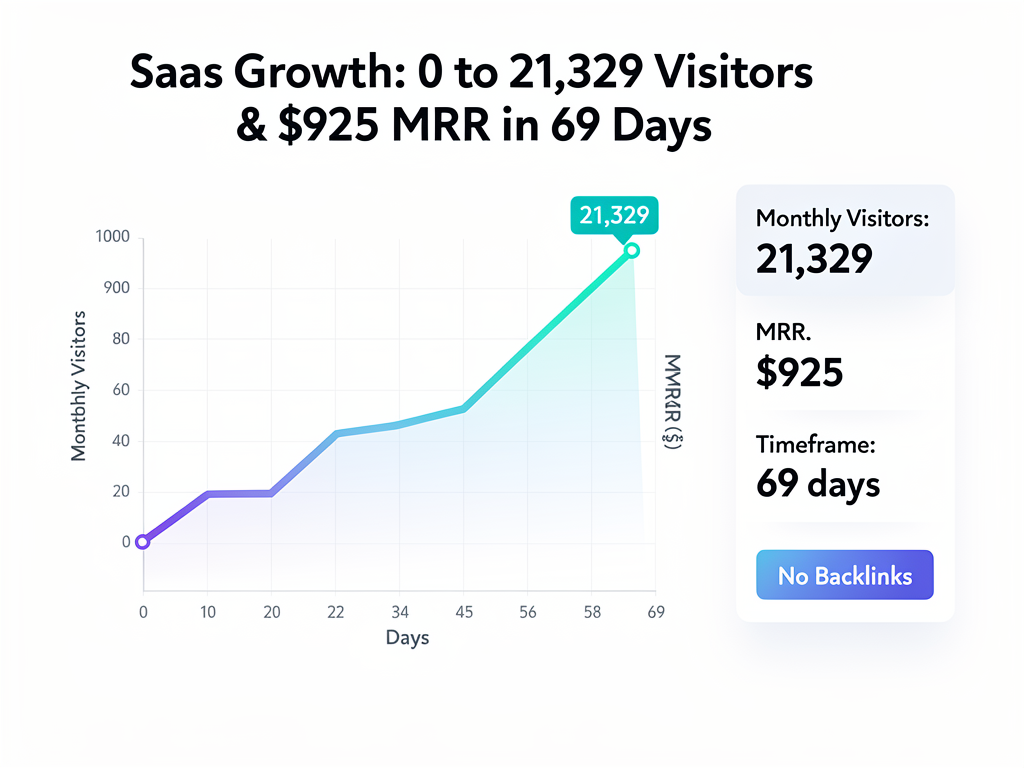
Case 4: New SaaS Achieves $13.8K ARR with Zero Backlinks Using Intent-Driven SEO Content
Context: A new SaaS product launched 69 days prior to this report. Instead of chasing backlinks or writing generic guides, they focused on high-intent keywords (people actively searching for alternatives, fixes, and problem-solving). Their domain rating was only 3.5 (brand new), yet they ranked for multiple keywords on page 1 of Google.
What they did:
- Identified customer pain points by reading Discord chats, Reddit discussions, and competitor roadmaps.
- Targeted keywords showing buying intent: “X alternative,” “X not working,” “How to do X in Y for free.”
- Wrote human-friendly content addressing the specific problem and offering a solution.
- Used short sentences, clear structure, callout blocks, and internal linking to related guides.
- Did zero outreach for backlinks; relied on content quality and internal structure.
Results:
- Before: New domain, zero traffic, zero users.
- After: 21,329 monthly visitors, 2,777 search clicks, $925 MRR from SEO alone, $13,800 ARR, 62 paid users within 69 days.
- Growth: Multiple blog posts ranking #1 or high on page 1. Organic search became primary user acquisition channel. Featured in ChatGPT and Perplexity without paid PR agencies.
Key insight: Blockchain projects chasing backlinks or trying to get press coverage are wasting time. Users are searching for problems and alternatives. Write content solving those problems, structure it for AI systems, and watch organic users arrive. This founder proved it works from day 1 with zero backlinks.
Source: Tweet
Case 5: AI Theme Pages Generate $1.2M Monthly Revenue Using Sora 2 and Veo 3.1 AI Tools
Context: An operator discovered that niche theme pages—focused on specific visual or content themes—could be built with AI video generators, filled with viral-ready hooks, and monetized at significant scale.
What they did:
- Used Sora 2 and Veo 3.1 to generate video content at scale.
- Created consistent content format: strong hook (stops scroll) → curiosity/value in middle → payoff + product tie-in.
- Posted repurposed content in niches already buying (fitness, crypto, finance).
- Built multiple theme pages, each running independently.
Results:
- Before: Unknown baseline.
- After: $1.2M/month total revenue across theme pages. Individual pages generating $100K+/month consistently. Largest pages pulling 120M+ views/month.
- Growth: Multiple pages scaling to 6-7 figures monthly without personal brand or influencer dependency. Pure content distribution in pre-buying niches.
Key insight: For blockchain PR, this proves that repurposed, well-hooks content in buying-ready communities scales fast. You don’t need personal brand or influencer status. Consistent output of high-quality hooks + distribution = revenue. Blockchain projects could apply this to theme pages about “DeFi Hacks,” “Blockchain News,” or “Crypto Portfolio Tips.”
Source: Tweet
Case 6: Creative OS Generates $10K+ in Marketing Assets in Under 60 Seconds
Context: A marketer reverse-engineered a $47M creative database and built an automated system that generates ultra-realistic marketing creatives (images and videos) in parallel using multiple AI models.
What they did:
- Extracted methodology and patterns from Emily’s $47M creative database.
- Built n8n workflow running 6 image models + 3 video models simultaneously.
- Used JSON context profiles (200+) to pass brand specifications, lighting preferences, composition rules, and product context.
- Automated asset upload and formatting across platforms (NotebookLM, etc.).
Results:
- Before: Manual creative production taking 5–7 days per campaign.
- After: $10K+ worth of publication-ready creatives in under 60 seconds. Ultra-realistic photos and Veo3-quality videos. Automatic lighting and composition matching brand guidelines.
- Growth: Massive time arbitrage. What took weeks now takes seconds. Enables unlimited A/B testing and rapid iteration.
Key insight: Blockchain projects can stop waiting for designers. Build a Creative OS (or use existing tools like RunwayML, Ideogram, or Synthesia) to generate ad creatives, promotional videos, and thumbnail images in seconds. This is now a baseline capability, not a luxury.
Source: Tweet
Case 7: AI-Powered Content Engine Generates 200 Publication-Ready Articles in 3 Hours, Capturing $100K+ in Organic Traffic Value
Context: An operator built an automated workflow extracting high-value keywords, scraping competitor content (99.5% success rate, never blocked), and generating ranking articles that outperform human writers.
What they did:
- Extracted goldmine keywords from Google Trends automatically (high volume, low competition).
- Scraped competitor websites with 99.5% reliability.
- Fed keywords and competitor context into an AI system that generated SEO-optimized articles.
- Set up in 30 minutes using native n8n Scrapeless nodes (no broken APIs).
Results:
- Before: Manual blogging at 2 posts/month.
- After: 200 publication-ready articles in 3 hours. Page-1 Google rankings achieved within weeks. Estimated $100K+ in organic traffic value per month.
- Growth: Eliminated content bottleneck. Replaces $10K/month content team. Zero ongoing costs after initial setup.
Key insight: Blockchain projects drowning in manual content production should automate keyword research and content generation. This workflow could generate 200 blog posts about crypto niches (“Best Solana Validators,” “DeFi Comparisons,” etc.) in 3 hours. Your competitors won’t catch up.
Source: Tweet
Case 8: Content Repurposing System Scales to $10K Monthly Profit with Minimal Effort
Context: An operator created an X profile in a niche, studied top influencers, repurposed their content using AI, and auto-scheduled posts to generate 1M+ monthly views and a DM sales funnel.
What they did:
- Created X profile in a buying-ready niche (ecommerce, AI, sales, etc.).
- Analyzed top influencers in the niche; identified content patterns, hooks, and value delivery.
- Used AI to repurpose that content into hundreds of unique posts (same message, different framing).
- Auto-scheduled 10 posts/day using buffer or similar tool.
- Built a DM funnel offering digital products ($500 price point, positioned as premium info products).
- Used AI to generate 5 e-books in ~30 minutes as lead magnets / sales assets.
Results:
- Before: Unknown baseline (new profile).
- After: 7 figures in profit annually. 1M+ monthly views. Few hundred checkout views/month. ~20 buyers per month at $500 each = $10K/month recurring.
- Growth: Lazy system, minimal ongoing work, compound growth from consistent distribution.
Key insight: Blockchain projects can apply this directly: create a token/crypto-focused X account, repurpose content from top accounts (block explorers, wallet blogs, DeFi influencers), and position it as a premium education/alert service. If you can get 20 subscribers at $500/year, that’s $10K/month recurring from one person doing 1 hour/day of setup and scheduling.
Source: Tweet
Case 9: AI Ad Agency Scales from $0 to $10M ARR in 12 Months Using Multi-Channel Growth
Context: An AI ad creation tool (Arcads) started from zero with founders reaching out to their ideal customer profile manually. They grew systematically through multiple channels: paid ads, direct outreach, viral moments, events, influencers, and partnerships.
What they did:
- $0–$10K MRR (1 month): Sent direct emails to ICP: “We’re building a tool for 10x ad variations. Want to test?” Charged $1,000 for early access. Closed 3 out of 4 qualifying calls.
- $10K–$30K MRR: Built product, started posting daily on X with zero followers. Booked demos consistently. People loved the product.
- $30K–$100K MRR: A client posted a video created with Arcads; it went viral. Saved them 6 months of grinding.
- $100K–$833K MRR ($10M ARR): Deployed 6 channels in parallel: (1) Paid ads using their own tool, (2) Direct outreach to top prospects, (3) Events and conferences with live demos, (4) Influencer partnerships in growth/AI space, (5) Coordinated product launch campaigns, (6) Strategic partnerships with complementary tools.
Results:
- Before: $0 MRR, no product, no audience.
- After: $10M ARR ($833K MRR at exit point), proven multi-channel playbook.
- Growth: Each stage revealed new channels; founders never settled on one lever. Viral moment saved 6 months but wasn’t the only driver.
Key insight: Blockchain projects obsessing over one growth channel (Discord, Reddit, Twitter) are handicapping themselves. The $10M ARR path required 6 channels running simultaneously. For crypto, this means: Twitter + Reddit + email + paid ads + events + strategic partnerships. Don’t pick one; run all in parallel, measure, and reinvest in winners.
Source: Tweet
Case 10: Search Traffic Grows 418%, AI Search Visibility +1000% Using AI-Optimized Content Structure
Context: A competitive SaaS agency repositioned their entire content strategy around commercial intent, rewrote for AI extraction (TL;DRs, question-based headers, extractable answers), built authority from DR50+ domains, and optimized for both Google and AI Overviews.
What they did:
- Stopped writing generic “thought leadership” and shifted to commercial intent: “Top [service] agencies,” “Best [service] for SaaS,” “[service] examples that convert.”
- Restructured every article with: TL;DR at top → question-based headers → 2–3 sentence answers → lists and facts over opinions → schema markup for brand and category.
- Built backlinks exclusively from DR50+ related domains with entity alignment (mentioning their niche and country consistently).
- Added brand and location schema, team pages, review pages with structured data.
- Rebuilt internal linking to pass semantic meaning (every service page links to 3–4 supporting blogs; blogs link back using intent-driven anchors).
- Created 60 AI-optimized “best of” and comparison pages with clean HTML structures and FAQs.
Results:
- Before: Standard organic traffic, minimal AI citations.
- After: Organic search traffic +418%. AI search traffic +1000% (Google AI Overviews, ChatGPT, Gemini, Perplexity citations). Massive growth in keyword rankings, citations from geographic targets, and visibility across AI platforms.
- Growth: Compounded results with zero additional ad spend. 80% customer reorder rate, indicating long-term value.
Key insight: This is the gold standard for blockchain PR today. Blockchain projects should immediately adopt this structure: reposition content to commercial intent, add TL;DRs and question headers, build strategic links from relevant high-authority domains, add schema, and link semantically. Result: 4–10x growth in search and AI visibility within 60–90 days.
Source: Tweet
Case 11: AI Copywriting System Turns AI Slop into Viral Content, Scaling from 200 Impressions to 50K+ Per Post
Context: An operator reverse-engineered 10,000+ viral posts, extracted psychological frameworks and neuroscience triggers, and built a system that uses AI to systematically generate viral content.
What they did:
- Analyzed 10,000+ viral posts across platforms to identify common psychological patterns.
- Extracted 47+ tested engagement hacks and trigger frameworks.
- Built advanced prompt architecture that feeds AI specific frameworks, not generic prompts.
- Created viral hooks using neuroscience: curiosity gaps, social proof, urgency, FOMO, pattern interrupts.
- Tested frameworks against content database continuously.
Results:
- Before: 200 impressions per post, 0.8% engagement, stagnant follower growth.
- After: 50K+ impressions per post consistently, 12%+ engagement, 500+ daily followers, 5M+ impressions in 30 days.
- Growth: Viral content on demand instead of lottery. Engagement jumped 15x; follower growth accelerated 50+x.
Key insight: For blockchain PR on social, this framework is essential. Don’t prompt ChatGPT generically. Feed it psychological hooks: “Curiosity gap about upcoming tokenomics + social proof of early adopters + FOMO about staking deadline” → results are 50x more engaging. Blockchain projects using this approach to Twitter will dominate their niches.
Source: Tweet
Tools and Next Steps
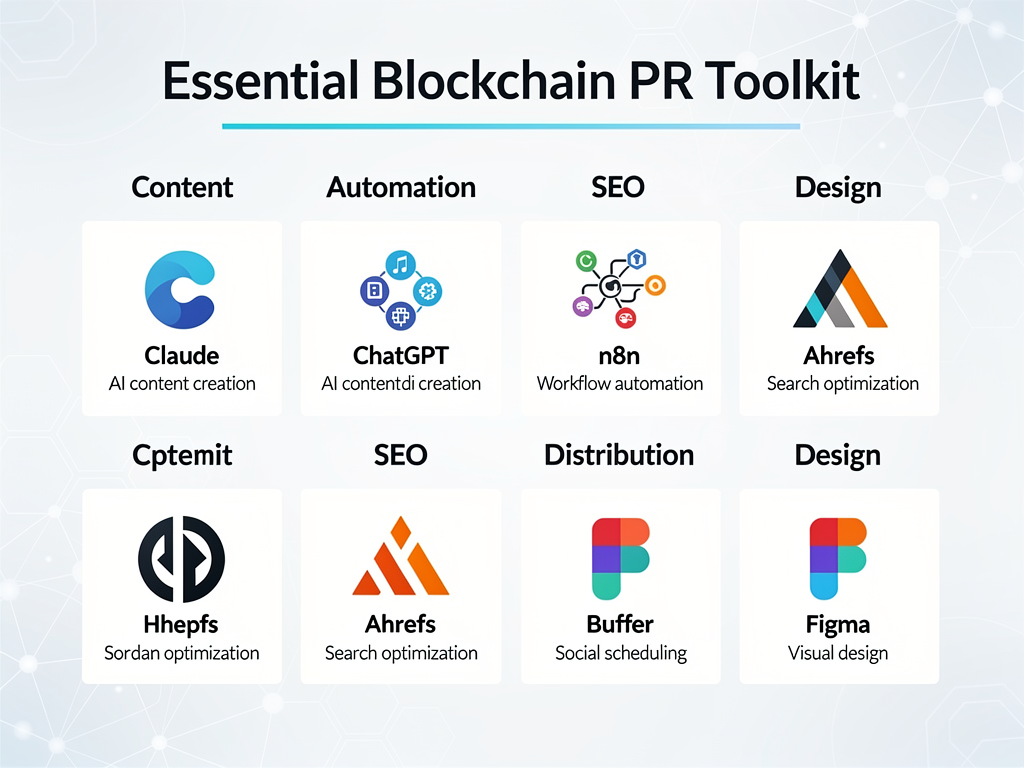
Essential Tools for Modern Blockchain PR
Content Creation: Claude (copywriting), ChatGPT (research and ideation), Higgsfield or Ideogram (AI images), Runway or Synthesia (video).
Workflow Automation: n8n (open-source automation), Zapier (SaaS integration), Make (workflow builder).
SEO and Analytics: Ahrefs, Semrush, or Google Search Console (keyword research and ranking tracking), Perplexity (AI search optimization), Google Trends (search volume verification).
Distribution and Scheduling: Buffer, Later, or Hootsuite (social scheduling), Substack or Ghost (email and publishing), Discord bots for community automation.
Creative Optimization: Figma (design feedback loop), Canva (quick visuals), NotebookLM (content transformation).
Blockchain PR Launch Checklist
- [ ] Identify 10 real user pain points — Join Discord, Reddit, Telegram; read support chats and competitor roadmaps. List 3–5 specific frustrations your users voice.
- [ ] Verify search volume for each pain point — Use Google Trends or Ahrefs to confirm people are searching for solutions. Write only about pain points with 100+ monthly searches.
- [ ] Write or outline 3 foundational blog posts manually — Don’t start with AI. Write your own thinking first (outline, key points, examples). This ensures accuracy and voice.
- [ ] Expand each post using Claude with structural prompts — Feed Claude your outline with instructions: “Add question-based headers, TL;DR, 2–3 sentence answers, lists, and FAQ. Keep it conversational.”
- [ ] Add AI extraction structure to each post — TL;DR at top, question headers, short answers, lists, schema markup (JSON-LD) for your organization/brand.
- [ ] Build internal linking web — Every blog post should link to 3–5 related pages. Use intent-driven anchor text (“enterprise blockchain validators” not “learn more”).
- [ ] Create 5 social media variants per blog post — Twitter thread, LinkedIn post, Reddit discussion starter, Discord snippet, email snippet. Use scheduling tool to auto-post.
- [ ] Identify and reach out to 20 DR50+ backlink prospects — Find relevant high-authority sites in your niche. Pitch your unique angle or data. Build 3–5 backlinks from quality domains only.
- [ ] Set up Google Search Console and track rankings daily — Monitor impressions, clicks, and rank positions for your target keywords weekly. Note which pages drive conversions (not just clicks).
- [ ] Request early user feedback on blog + content — Ask 5–10 engaged community members: “Which topics would help you most?” “What are your biggest blockers?” Adjust content roadmap based on answers.
For blockchain teams ready to scale beyond these fundamentals—especially when building integrated PR strategies across content, influencer outreach, and AI search optimization—FLEXE.io has 7+ years working with 700+ Web3 projects and offers direct access to 10+ crypto traffic sources, 150+ media outlets, and 500+ KOLs to drive rapid user acquisition. DM us on Telegram: https://t.me/flexe_io_agency
FAQ: Your Questions Answered
What’s the difference between blockchain PR and traditional PR?
Traditional PR focuses on media placements and press coverage in outlets. Blockchain PR today prioritizes user acquisition through search visibility, AI citations, social distribution, and community engagement. Users find your content when searching for solutions, not because a journalist wrote about you. Both matter, but user-first content drives far more measurable growth.
How long does it take to see results from blockchain PR content?
SEO rankings typically take 4–12 weeks for competitive keywords, but high-intent, low-volume keywords can rank in 1–2 weeks. Social content can drive traffic immediately (within 24 hours). Email and community engagement start yielding results within 2–4 weeks. One SaaS founder saw $925 MRR in search revenue within 69 days from launch with zero backlinks—it’s faster than traditional PR but requires consistent effort.
How much should a blockchain project budget for AI tools and automation?
Essential tools (Claude Pro, ChatGPT Plus, Ahrefs, Semrush, automation platforms) cost $200–400/month. For full-stack automation (video generation, advanced AI agents, premium email), budget $500–1,000/month. One operator replaced a $250K/year team with $500/month in tools. The ROI is extreme: if your content generates even $5K/month in user acquisition, your tools pay for themselves 10x over.
Should blockchain projects focus on Google SEO or AI search (ChatGPT, Perplexity)?
Both, simultaneously. Google still drives the majority of search traffic, but AI systems (ChatGPT, Perplexity, Gemini, Google AI Overviews) are becoming citation sources. One agency grew AI search citations from zero to 100+ by restructuring content with TL;DRs and question-based headers. Do both: optimize for traditional Google + add AI extraction structure (which also helps Google). You’ll capture users across both systems.
Can one person handle all of blockchain PR (content, social, SEO)?
Yes, with heavy automation. One founder runs a $50K MRR product mostly solo using AI content generation, auto-scheduling, and email automation. Focus your human time on strategy (listening to users, analyzing competitors, identifying high-intent keywords), then use AI to scale execution (writing, design, posting, email sequences). Hire for tasks that don’t scale easily (community management, strategic partnerships) only after revenue justifies it.
What’s the biggest mistake blockchain projects make with AI-generated content?
Publishing raw AI output without human editing or testing. Engagement stays below 2% because the content sounds flat and generic. Winning teams reverse-engineer successful content first, then brief AI with specific patterns and voice guidelines. Example: instead of “write a tweet,” use “Write a tweet using the ‘curiosity gap’ hook from this example, add social proof, and end with a clear call-to-action.” Results jumped from 12 likes to 50K+.
How do blockchain projects build authority when they’re brand new?
Write content solving real problems first, build backlinks from relevant high-authority domains second, add schema markup for entity alignment third. One new SaaS got 21,329 monthly visitors and $925 MRR without backlinks by focusing on high-intent keywords and internal linking. Authority builds faster through content quality + user intent than through chase of prestigious links. ChatGPT and AI Overviews help cite new projects faster than Google traditionally did.
Is blockchain PR different for Layer 1 blockchains vs. DeFi protocols vs. NFT projects?
The fundamentals (intent-driven content, multi-channel distribution, AI tools) are identical. The execution differs: Layer 1 projects should target “Why Solana over Ethereum” or “Best Solana validators”; DeFi should target “Lowest slippage DEX” or “Yield farming alternatives”; NFT should target “How to mint without gas fees” or “Alternative marketplaces.” Listen to your specific community’s pain points, write for those, and the framework applies universally.
Conclusion: Blockchain PR in 2025 Is About Users, Not Media
The winners in blockchain PR today aren’t chasing journalists or paying for thought leadership placements. They’re building content that solves real user problems, structuring it for visibility across Google and AI systems, and distributing it at scale using automation.
The evidence is overwhelming: one operator grew organic traffic 418% and AI search visibility 1000%. Another replaced a $250K marketing team with $500/month in AI tools. A third scaled from zero to $833K MRR using six parallel growth channels. None of this involved traditional PR agencies or press coverage as the primary driver.
For blockchain projects in 2025, the path is clear: identify real user pain points, write content solving those problems, structure for both humans and AI systems, build strategic backlinks from relevant high-authority domains, and distribute across social, email, and community simultaneously. Automate what you can, measure what matters (conversions and user acquisition, not just traffic), and iterate based on what moves the needle.
The blockchain projects that crack this will grow 10–100x faster than those still waiting for media coverage or betting on influencer mentions. The tools, the playbooks, and the proof are all available now. The only barrier is execution.