Crypto airdrop promotion here is a task campaign that delivers 2,000 verified participants across your X, Telegram and Discord accounts, with admin panel access for as long as it runs. It is easy to buy and easy to waste. What follows is how a run is put together, what you supply, what can change while it is live, what arrives at handover, how the price is set, and the failure modes that only show up a month later.
An airdrop attracts reward-seekers by design. Anyone who tells you otherwise is selling something. The question worth asking is not how to avoid them, but how many are still there a month after the reward lands. Airdrop ads, banners and listings on airdrop aggregator sites bring traffic fast, but the task list is what decides who qualifies.
What a Cryptocurrency Promotion Campaign Delivers
| Guaranteed participants | 2,000 across your social accounts |
| Task completion | Most participants complete several tasks, not one |
| Reporting | Direct access to the airdrop bot admin panel |
| Platforms | X, Telegram, Discord |
Admin panel access matters more than it sounds. You see completions as they happen rather than a summary at the end, which means a task nobody is finishing can be changed while the campaign is still running.
Airdrop Ads Bring Traffic, the Task List Decides the Audience
This is the whole campaign, and it is settled before launch. Ask only for a follow and you get people who follow for rewards. Ask for something that requires reading the project first – a question with an answer only in your docs, a testnet action, a wallet interaction – and the same budget produces a smaller, better list.
The trade is explicit: harder tasks mean fewer completions and a higher share of them still present later.
Airdrops work best alongside something that gives newcomers a reason to stay – see community growth for task campaigns generally and community management for keeping the channel alive once they arrive.
How crypto airdrop promotion runs
- Task list agreed first. This is the whole campaign and it is settled before launch, because it decides who shows up.
- Bot configured. Verification per task, anti-duplicate rules, and the admin panel handed to you.
- Distribution. The campaign is pushed across X, Telegram and Discord until the 2,000 verified participants are reached.
- Live correction. A task nobody completes gets changed while the campaign is still running, which is the reason panel access matters.
- Handover. Full completion data, so you can see who did what rather than a headline number.
What changes the cost
| Factor | Effect |
|---|---|
| Task difficulty | Harder tasks mean fewer completions per unit of distribution and a higher cost per verified participant |
| Wallet or KYC verification | Confirming a wallet action costs more than confirming a follow, and produces a far better list |
| Number of platforms | X, Telegram and Discord each need their own verification path |
| Participant count above 2,000 | The base campaign delivers 2,000 verified participants; larger runs scale from there |
| Deadline | A claim date fixed two weeks out compresses distribution and raises the cost |
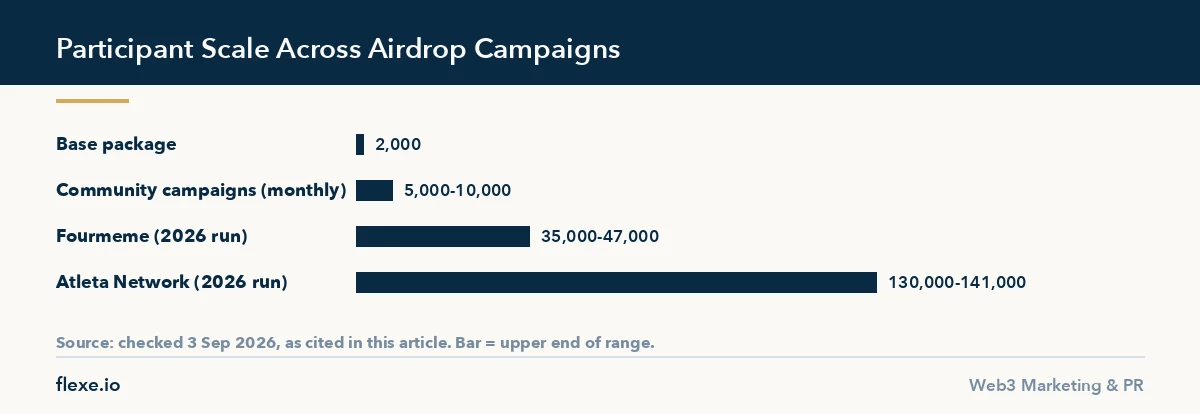
For reference on scale, our task-based community campaigns run from a minimum of 5,000 participants up to 10,000 a month, and documented 2026 runs include Fourmeme from 35,000 to 47,000 and Atleta Network from 130,000 to 141,000.
What to measure afterwards
Retention at 30 days is the only number that separates a campaign from a giveaway. Engagement rate before and after tells you whether the audience is inert: if the count rises and the rate collapses, you bought numbers. Where tokens are distributed, wallets still holding past the claim is the real result.
An airdrop brings people to a door. What happens after they walk through is crypto community management, and skipping it is why most airdrop audiences evaporate within a month.
Timeline from brief to handover
Days one to three are the task list and the bot. You send the token, the chain, the claim date and the channels. Back comes a proposed task list, the verification method for each task, and the anti-duplicate rules. Nothing goes live until that list is signed off, because changing entry requirements mid-run makes the earlier completions impossible to compare with the later ones.
Distribution runs from roughly day four until the verified count is reached, usually two to three weeks for the base 2,000 participants across X, Telegram and Discord. Handover follows within two working days of the campaign closing. A claim date fixed two weeks out compresses all of this and raises the cost, which is worth knowing before the date is announced publicly.
What you supply before launch
- Token, chain and contract address, plus whether the reward is liquid at claim or vested.
- The claim date, or an honest statement that it is not set yet. No date is workable. A date that moves twice is not.
- Admin rights on Telegram and Discord and the X account, so verification can read membership and follows.
- The reward size per participant and the total pool, since both decide how much task difficulty the list can carry.
- Docs or a landing page a task can point at, if any task requires reading something first.
- A named person who can approve a task change inside a day while the run is live.
Where the reward is vested rather than liquid, say so in the task copy. Participants who find out after completing the tasks leave and say so publicly, which costs more attention than the disclosure ever would have.
How the task list is built
The list starts from what a participant should have done by the time the reward lands, then works backwards to tasks a bot can confirm. Every task passes two checks: verification without a human reading screenshots, and completion on a phone in under two minutes by someone acting in good faith.
- Social tasks, a follow, a join, a repost. Cheap to verify, weakest filter, useful only as the entry step.
- Reading tasks, a question whose answer sits inside your docs. The cheapest way to remove pure farmers from a list.
- Product tasks, a testnet transaction or a wallet connection. The strongest filter and the most expensive to confirm.
- Referral tasks, capped rather than open, because uncapped referrals are what turn a campaign into a farm.
- Delayed tasks that open days after entry, which cost almost nothing and quietly show who is still around.
A workable list pairs the cheap entry step with at least one task that requires reading or touching the product. Lists built only from the first kind fill quickly and empty just as fast.
What changes while it is live
You get the bot admin panel, and its real value is correction speed. Completion rates per task are visible as they happen. A task most entrants skip is usually broken rather than hard: a link that fails on mobile, a verification that misreads a private account, a wallet step on a chain your audience does not use.
Changes are made forwards, never backwards. A replaced task applies to new entrants and earlier completions stand. One or two mid-run changes are normal and included. Rewriting the whole list halfway through is effectively a second campaign, because the two halves then describe two different audiences and their retention numbers cannot be read together.
Moderation while the run is live
A live campaign pushes questions into your channels faster than they usually arrive, and most of them are the same four: when is the claim, is this task broken, why was my entry rejected, and is this real. Whoever answers needs the task list, the rejection rules and the claim date in front of them, and needs to answer in the channel rather than in direct messages, because one public answer removes the next forty copies of the same question.
Rejections are where tempers go. Publishing the anti-duplicate rules before launch, in the same post as the task list, turns most complaints into a link rather than an argument. Entries rejected for a fixable reason are told what to fix, since a participant who corrects and completes is worth more than a tidier-looking number.
Hours matter too. Distribution is pushed when the target channels are awake and complaints arrive on the same clock, so someone has to be present in those windows rather than replying the next morning.
What arrives at handover
- The full participant export: handle per platform, wallet where a wallet task was set, task-by-task completion, timestamps.
- Duplicates and rejected entries as a separate sheet, with the reason for each rejection.
- Completion rate per task, which is the most reusable output you get for the next campaign.
- Channel by channel growth across the run as a daily curve, not a start and end number.
- A short written read on which tasks produced people who kept engaging after the reward landed.
The export is yours. We do not keep the list, resell it, or reuse it for another client, and nothing in it sits behind a login of ours.
How the price is set
Pricing follows verified participants and the cost of verifying them, not impressions. Confirming a follow is cheap. Confirming a testnet transaction is expensive and produces a far better list, and that trade is the thing you are actually buying. Crypto airdrop promotion as a focused single-channel run starts at $4,000 here, while a full crypto marketing launch, where the airdrop is one part alongside media and creators, runs $50K to $500K across three to six months.
Beyond task difficulty, the quote moves on:
- Participant volume above the base 2,000, which scales but not in a straight line, because the easiest audience is reached first.
- KYC or geographic restrictions, each adding a verification path and removing part of the eligible audience.
- Platform count, since X, Telegram and Discord each need their own verification and their own moderation load.
- A compressed deadline, which buys the same distribution in less time and at a worse rate.
- Language coverage, where a second language needs its own copy, its own channels and usually its own moderator.
How the result is judged
Retention at 30 days settles whether crypto airdrop promotion bought you a campaign or a giveaway. Read it as distinct people still engaging weekly, not as follower count, which barely falls and therefore tells you almost nothing. Engagement rate before and after is the second read: a count that rises while the rate collapses means you bought an inert audience. The same test applies to any cryptocurrency promotion: cryptocurrency promotions that end with no returning users bought attention, not holders.
Where tokens are distributed, wallets still holding past the claim is the honest measure. Expect a minority, and judge the run on cost per surviving wallet rather than cost per participant. That single change of denominator is what makes a harder task list look cheap in hindsight and a follow-only list look expensive.
Failure modes we see
The most common failure is a campaign that ends the day the reward lands, with nobody scheduled to talk to the arrivals. The run brings people to a door, and if the channel behind it is silent for a week they leave, after which the 30 day number reads as a failure of the campaign rather than of the follow-up. That handover is what community management exists for.
The second is announcing a claim date and then moving it, which costs more trust than the delay itself. The third is a reward large enough to attract industrial farming paired with a task list too weak to filter it, producing a headline number and a dead channel. The fourth is treating the airdrop as the entire launch. Our own numbers point the other way as well: a budget spread across too many channels at once correlates with a 34 percent failure rate, so the answer is not buying everything, it is picking two channels that reinforce each other and funding both properly.
Who this is not for
If there is nothing to come back to, the run will deliver participants and nothing else, and the 30 day number will say so plainly. If what you want is trading volume, we do not sell it and will not quote it. If you want a guaranteed count of engaged holders rather than verified participants, no honest vendor can price that either, and the ones who do are pricing something they cannot control.
Across more than 800 campaigns since 2018 the pattern holds: a task-based run works as an entry point for a project that already has something worth entering. Used to manufacture the appearance of a community, it produces a number that the next investor checks and discounts inside an afternoon.
Frequently Asked Questions
Will these people stay?
Some will, and the share is decided by the task list rather than by the size of the reward. Follow-only tasks produce reward-seekers. Tasks that require reading the docs or touching a testnet produce a smaller and much better list.
How many participants do we get?
The base campaign delivers 2,000 verified participants across your social accounts, with most completing several tasks rather than one. Larger runs are quoted separately. Verified means the bot checked the task was actually done, not that a wallet clicked once, which is why the figure is lower than the raw click counts quoted elsewhere.
Can we see progress during the campaign?
Yes. You get direct access to the airdrop bot admin panel and see completions as they happen, which is how a failing task gets replaced mid-run. Nothing is reported to you after the fact that you could not already see yourself, and the panel stays available at handover for your own records.
Do you filter out farmers?
Verification catches duplicates and unfinished tasks. Farmers as a category are not filtered out by a rule, they are priced out by task design: a list that requires reading the docs or touching a testnet costs a farmer more time than the reward is worth. We do not claim to remove them entirely.
Do you distribute the tokens?
No. Distribution and the contract stay with you, and so does the legal responsibility for them. We run the campaign, the verification and the reporting, and hand over the participant list in a format your distribution script can read. Deciding who is eligible is your call, not ours.
Tell Us What You Are Distributing
Send the token, the chain and the claim date. You get back a proposed task list and an honest read on how much of the audience is likely to remain.